
AI now has a clear place in creative work, and most marketing teams are already using it in some form. It helps speed up ideation, supports production, and removes some of the friction that slows teams down. Those gains are real, and they are part of why AI has become a normal feature of modern workflows.
The more useful question is not whether AI belongs in the process, but what role it should actually play. Strong creative still depends on decisions about message, tone, brand fit, and execution, and those decisions do not become less important simply because the tools become faster. AI can help teams move, but it does not remove the need for people who know how to judge the work, refine it, and decide what is strong enough to go live.
Truth 1: AI is strongest when the job is acceleration, not judgment
AI is most useful when the task is to help a team move faster. It can generate starting points, surface more routes to review, and support parts of the workflow that used to take much longer. That is valuable, especially when the volume of content is high and timelines are tight.
But creative quality is rarely decided at the point of generation. It is decided when someone chooses the right direction, rewrites what feels generic, refines what sounds off, and shapes the work into something that feels specific to the brand. In other words, AI can help create material, but it still takes expert judgment to turn that material into strong creative.
Truth 2: Different AI tools do different jobs
One reason the AI discussion gets messy is that people often speak about AI as if it is one thing. In reality, different tools solve very different parts of the workflow. A general-purpose LLM is useful for ideation and drafting, while a design platform helps with asset generation, and a campaign automation tool helps with delivery and optimization.
Once those roles are separated, the conversation becomes clearer. The real issue is not whether AI is being used, but whether the right people are still shaping the parts of the work that determine quality, distinctiveness, and brand fit. This is where the human orchestrator comes in. AI tools, while powerful, are not a fully automated, hands-off system. A person is still needed to integrate the ideas and outputs from these various tools into one cohesive final product. AI functions as a collection of advanced tools, and even when integrated, human intervention and technical skill are essential for ultimate quality and consistency.
Truth 3: The strongest model is AI-assisted and expert-led
The best creative systems are not anti-AI, and they are not fully automated either. They use AI where it adds speed and efficiency, and they rely on skilled people where the work needs strategy, technical control, and creative judgment.
That is the model VMG Digital is building toward. We use public tools where they genuinely improve the workflow, and we also develop internal systems that help the team work with more structure and less process drag. But the quality of the final work still depends on the people shaping it, because they are the ones making decisions about brand fit, message hierarchy, execution, and audience relevance.
This matters because the human role is not just about instinct or taste. It is also about technical skill. Strong creative work still requires specialists who know how to build messaging, shape design systems, edit video properly, structure campaigns, and evaluate performance with context.
That distinction is important because it stops the conversation from becoming too abstract. The question is not simply whether humans should stay involved. The better question is what kind of expertise still has to sit inside the process, and the answer is clear: a great deal of it still does.
Beyond Automation: Skilled Hands Guide Smart Tools
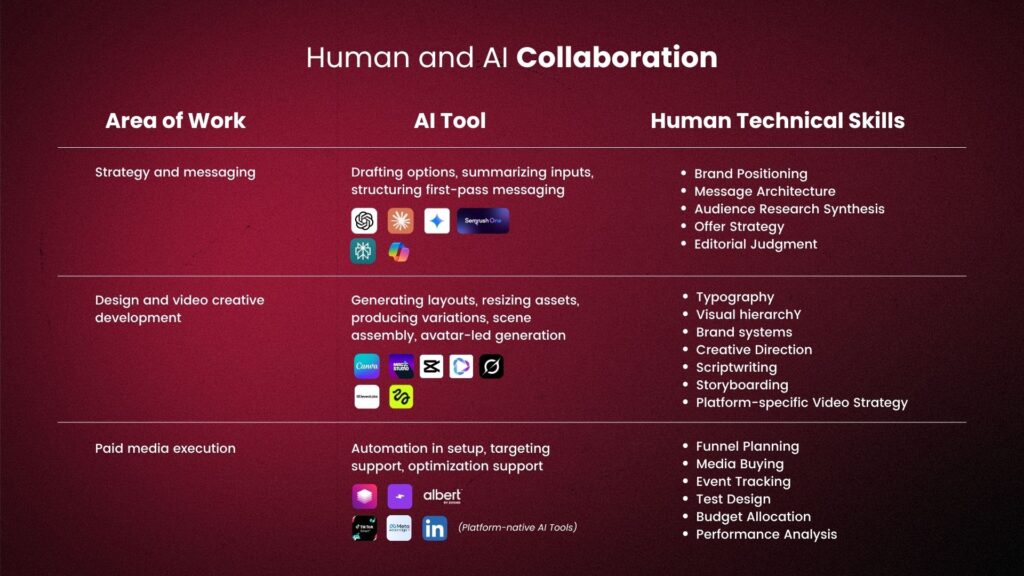
This framework below illustrates how AI tools and human expertise complement each other across strategy, creative development, and media execution.
In each area, AI tools provide speed and automation, but human expertise ensures the outputs are strategic, creative, and effective. In strategy and messaging, AI can draft and summarize, but humans bring brand positioning, audience insights, and editorial judgment. In design and video development, AI generates layouts and variations, while humans apply typography, creative direction, and storytelling. And in paid media execution, AI supports automation and optimization, but humans design funnels, allocate budgets, and analyze performance. In every case, the tools accelerate the process, but human expertise ensures the work is effective, on‑brand, and impactful.
Why this matters for brands:
For brands, this is not just an internal workflow discussion. Creative is one of the main ways the market learns how to interpret the business, and that means the quality of the work affects trust, memorability, and perceived relevance. If too much of that work starts to feel generic, then the brand begins to lose the sharpness that makes it distinct.
That is why the better model is not tool-led creative. It is expert-led creative with strong tools inside the process. Brands still need people who can think strategically, execute technically, and make decisions that protect the quality of the work while still taking advantage of the speed AI can offer.
At VMG Digital, that is the balance we aim for. We want the efficiency gains, the smarter systems, and the workflow improvements, but we also want the final work to feel considered, well-crafted, and right for the brand.
The Key Takeaway
AI is now part of creative work, and it is useful in many of the places where teams need speed, structure, and production support. LLMs can help with ideation, design tools can accelerate asset creation, video tools can streamline production, and platform automation can improve campaign delivery. Those are meaningful advantages, and they are worth using.
But none of those tools replace the part of the job where quality is actually decided. They do not replace message strategy, design craft, editing judgment, or media expertise. They help the process move, but the final work still depends on people who know how to turn output into something strong.
That is why the future of creative is not AI alone, and it is not human effort without support. It is a better system that uses AI where it adds value and keeps experts in charge where the standard of the work is determined. At VMG Digital, that is the approach we believe in and the model we are continuing to build.
If you want creative that uses AI intelligently without losing the expertise that makes the work strategic, distinctive, and technically strong, connect with VMG Digital.
FAQ
1. Is this argument anti-AI?
No. The point is not to reject AI. The point is to use the right tools for the right tasks and avoid handing over decisions that still require expert judgment.
2. What kinds of skills still matter most in an AI-supported workflow?
Strategic messaging, design craft, scripting, editing, media planning, measurement, and QA all still matter. AI can assist the workflow, but it does not replace the technical depth behind good creative work.
3. Why does VMG Digital’s approach matter?
Because brands do not just need more output. They need output that is well judged, well executed, and aligned with the business. That requires both smart tools and skilled people.

Iya Hipolito
Iya Hipolito is a marketing executive at VMG Digital with nearly a decade of experience in the industry. She specializes in digital marketing strategy, content creation, social media management, and brand storytelling. Passionate about innovation and growth, Iya shares insights on marketing trends and practical approaches to building stronger brand presence online.