

TL;DR
Meta’s Creator Marketing Hub is making creator discovery, outreach and paid activation more connected.
The opportunity for marketers is to use that efficiency to focus on the parts that still require strategy:
- Give creators a clear role based on what the campaign needs them to achieve.
- Build beyond one asset by testing hooks, product proof, formats and CTAs.
- Use media as a learning tool to see which ideas deserve more investment.
- Feed performance into the next brief so each round of content gets smarter.
Creator sourcing may be getting easier. The real advantage is in connecting strategy, creative, media and performance more effectively.
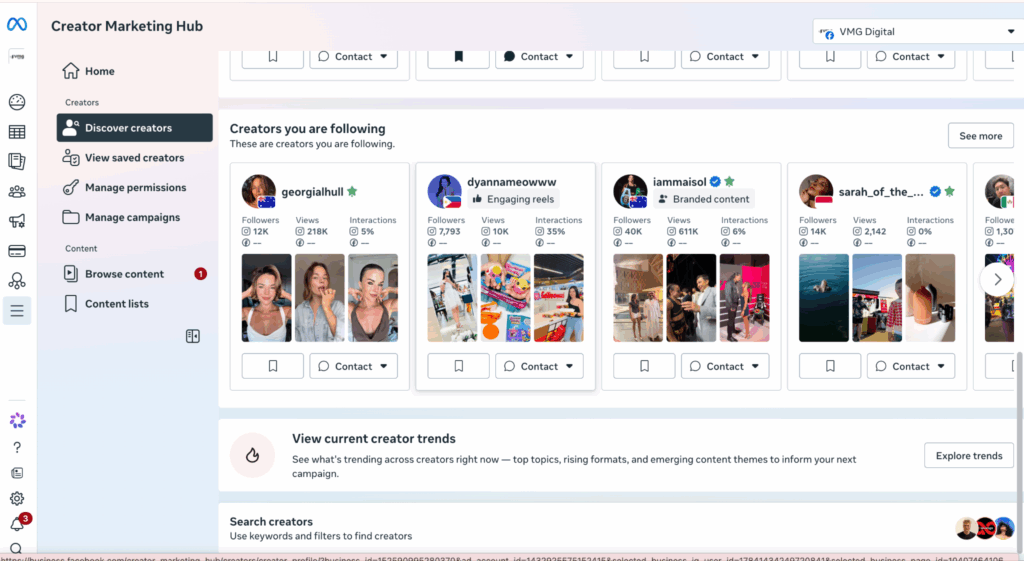
Meta is reducing the friction.
Meta’s new Creator Marketing Hub brings creator discovery, outreach, content evaluation and Partnership Ads into a more connected workflow. The important shift is the reduction in manual steps between finding creator content and activating it.
That gives marketers an opportunity to redirect attention toward the parts of creator marketing that require more judgment: choosing creators for a clear strategic role, developing ideas worth testing, and using performance signals to determine what should be made next.
Creator sourcing becomes the starting point
Creator-led campaigns typically involve strategy, sourcing, briefing, production, editing, adaptation and paid activation before meaningful performance learning begins. Meta is shortening parts of that process by combining Creator Marketplace and Partnership Ads Hub, expanding discovery tools and bringing creator outreach and ad activation into the same environment.
That efficiency matters, but sourcing alone has never defined a strong creator strategy. Finding someone who fits the audience is only the beginning. The more important decision is what role that creator should play in the campaign and what their content needs to achieve.
Give every creator a strategic role
Creator selection should connect directly to the campaign objective. A creator might be particularly effective at demonstrating a technical product, making an unfamiliar category easier to understand, building credibility around a claim, or turning a product benefit into a relatable story.
The brief should reflect that role. Rather than focusing mainly on deliverables and mandatories, it should establish the creative territory and the hypothesis being tested. If the objective is to prove a product benefit, for example, creators might explore that proof through demonstration, comparison, personal experience or a specific use case.
This gives the content a purpose beyond filling the asset plan. It also creates a stronger connection between creator strategy, creative development and the media decisions that follow.
A strong creator concept should go further than one asset
Meta is also making it easier for advertisers to identify strong organic creator content and determine which assets are ready for advertising.
For marketers, the opportunity goes beyond putting additional spend behind the original post. A concept that shows potential can become the foundation of a broader testing system.
- Test the hook. Keep the core idea but explore different openings, such as a direct benefit, personal story, product demonstration or audience problem. This helps isolate whether the concept works because of the underlying idea or the way it was introduced.
- Develop the product proof. A useful demonstration can become a comparison, testimonial, use case or shorter performance edit. The aim is to build around the strongest part of the original concept rather than simply producing more versions of the same asset.
- Vary commercial intent. The same creative territory can support consideration-led messaging, stronger product benefits, offers or different CTAs. This gives media teams genuinely different creative inputs to test.
- Extend the idea across formats and markets. Creator-led concepts can inform cutdowns, statics, localized executions, UGC-style variations and future creator briefs when the underlying insight remains intact.
This is where creator production begins to generate more than content. Each execution can add evidence about the messages, formats and creative approaches that deserve further investment.
Media should help creative learn
Creator campaigns are often run as a sequence: creative produces the asset, media distributes it and performance reports what happened. That structure leaves valuable information at the end of the process.
A stronger model feeds those signals back into the next creative decision. Organic response can indicate where an idea has traction. Paid media can test whether that response holds with a broader audience. Performance can then show which elements deserve to be scaled, adapted or reconsidered.
Meta is moving in this direction as well. In its June announcement, the company described new tools designed to create a shared environment for creative and media teams, using campaign performance to inform subsequent creative decisions.
For marketers, that creates a more useful operating loop:
Creator strategy → Creative → Media → Performance → Next creative decision
The next brief should be smarter than the last
When a creator asset performs well, increasing spend may be appropriate. But the result should also inform the next brief.
Teams should identify what appears to be driving the response. Was the hook particularly effective? Did the creator make a complex benefit easier to understand? Did a demonstration provide stronger product proof? Did a particular format make the message feel more credible?
Those observations become inputs for the next round of creative development. Over time, creator campaigns can build a clearer body of knowledge around which messages resonate, which creators work best for different roles and which ideas continue to perform when they move from organic content into paid media.
Performance then becomes more than a campaign scorecard. It becomes part of the creative strategy.
Easier execution should create room for better strategy
Meta’s Creator Marketing Hub removes friction from work marketers already need to manage. Discovery, creator communication, content evaluation and paid activation are becoming increasingly connected, with further AI-assisted capabilities being added to the workflow.
The value of that efficiency depends on where teams reinvest it.
There is more room to sharpen creator selection, strengthen briefs, build deliberate testing plans and develop successful concepts beyond their first execution. For agencies and in-house teams alike, this is where Creative × Media × Performance becomes more useful as one connected system rather than three separate workstreams.
Creator sourcing remains important. But stronger creator marketing will increasingly depend on what surrounds it: the strategy behind the creator, the idea they are asked to develop, how that idea is amplified and what the team learns from the response.
Meta is making more of the execution easier. Marketers can use that headroom to make the strategy work harder.